Lifestack
Lifestack AI Planner & Recovery-Aware Calendar (Male user)
Lifestack is an AI-powered planner that pulls recovery data from wearables like Oura to help schedule work and workouts around physiological readiness.
### Overview
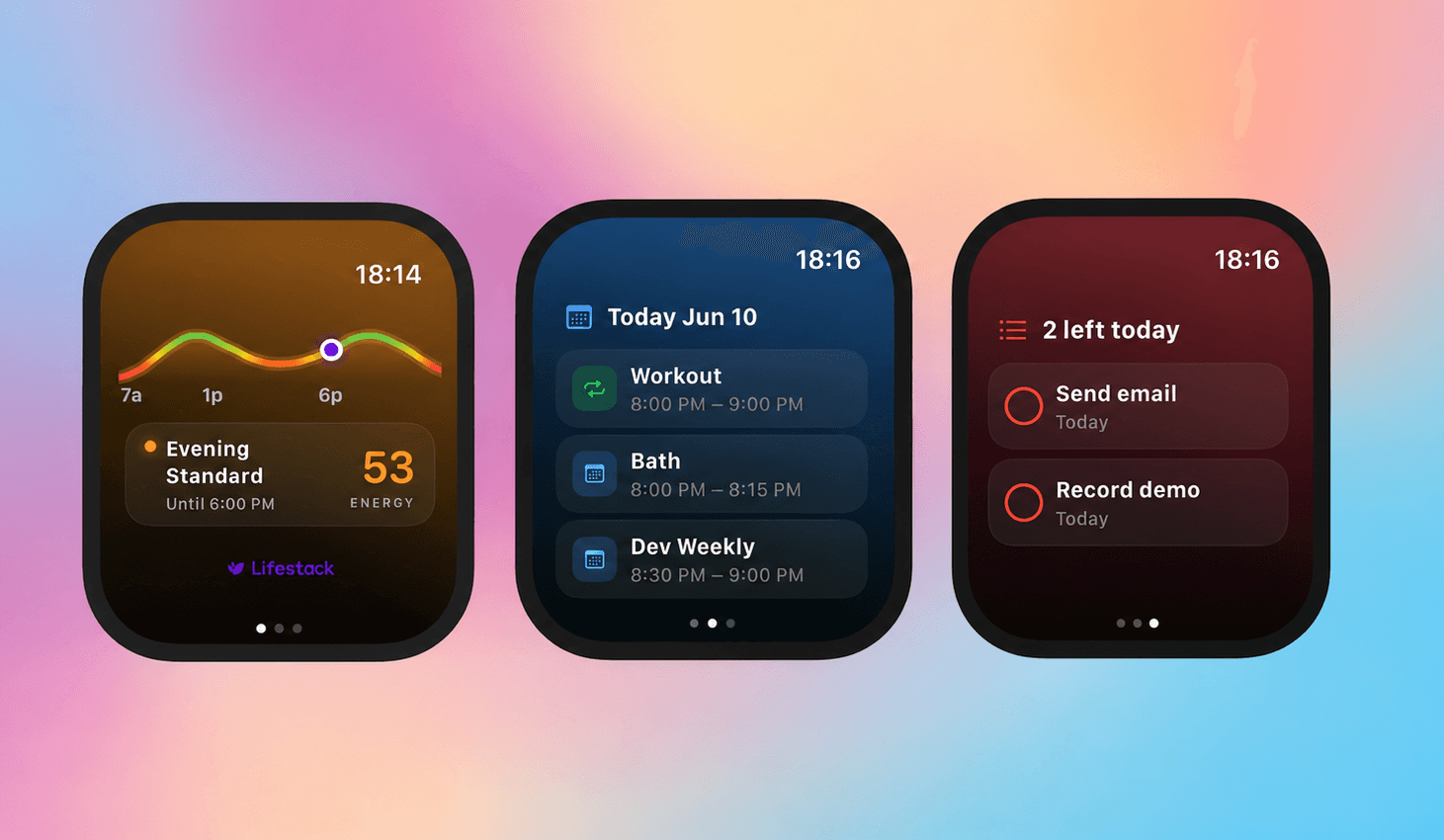
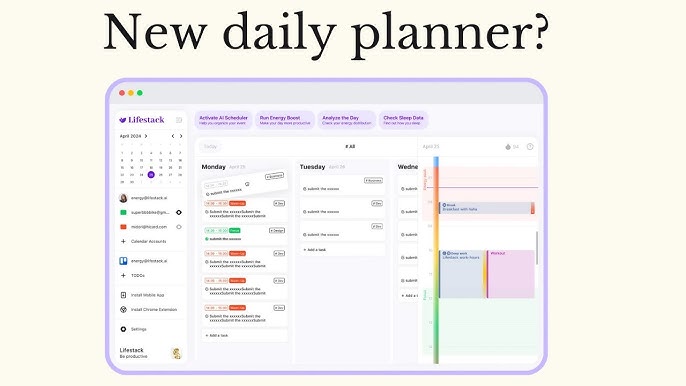
Lifestack is a health-driven AI daily planner that goes beyond conventional scheduling by learning your circadian rhythm and energy patterns — pulling biometric data from wearables like the Oura Ring, WHOOP, Apple Watch, Fitbit, and Garmin — then intelligently scheduling tasks to match your peak focus hours and recovery periods. Where most calendar apps treat every hour of the day the same, Lifestack factors in your personal energy patterns: when you're sharp, when you'll crash, and when to protect recovery time. Pricing runs $7/month, $50/year (with a 7-day free trial), or $120 as a one-time lifetime purchase.
---
### Pros
- **Closes the loop between Oura data and your calendar:** Lifestack takes your sleep quality, HRV, and recovery data from the Oura Ring and uses it to build your daily schedule automatically — your most demanding tasks land in peak cognitive hours, and low-recovery days get lighter schedules without you having to manually adjust anything. If you're already wearing an Oura Ring, this is the missing layer that makes that data actionable rather than just informational. - **Adaptive real-time rescheduling:** When your plan gets disrupted — which happens every day — Lifestack reschedules automatically. A meeting that runs over doesn't collapse the rest of your day, and an important call that gets moved doesn't require you to manually rebuild your afternoon. This is a meaningful edge over static time-blocking tools. - **AI chat copilot for natural-language planning:** The built-in AI chat copilot acts like a personal coach, helping you plan your day, week, or routines in natural language — you can say things like "Plan my entire day" or "When should I prepare slides?" and Lifestack suggests optimal times. - **Accessible pricing with a lifetime option:** At $7/month or $50/year, it's significantly cheaper than comparable tools like Sunsama's $17 minimum. There's also a $120 lifetime option, which removes the subscription question entirely for long-term users.
---
### Cons
- **Wearable dependency for core value:** While Lifestack works without a wearable, it functions best with one — devices like the Oura Ring provide the real-time health data that powers the AI scheduling and energy heatmap. Without one, you're limited to basic task management and calendar features. The Oura Ring itself starts at $299 plus a $5.99/month membership, so the total cost of the full setup is higher than the app price alone. - **Energy model takes time to calibrate:** The energy model improves with use over time, not immediately — new users shouldn't expect perfectly optimized schedules from day one, and you'll get the most benefit if your Oura data is consistent. - **Fewer third-party task integrations than some rivals:** Lifestack has fewer third-party task integrations than tools like Sunsama — notably, no Linear or GitHub sync yet — which may matter for developers or engineering teams who live in those tools. - **No free plan after trial:** Lifestack offers a 7-day free trial with full feature access, but after the trial, a subscription is required ($4.99/month or $3.50/month annually). There is no free plan after the trial ends.
---
### Who It's For
This app is built for anyone who wears a smartwatch and actually wants their health data to influence their productivity — particularly men who are already invested in the Oura ecosystem and want their readiness scores to do more than sit in a dashboard. On a high-energy morning, demanding tasks get front-loaded; on a low-recovery day, the routine adapts to protect quality rather than forcing a plan that doesn't fit how you actually feel — making it especially useful for athletes, founders, or knowledge workers who train hard and need their work schedule to respect recovery, not fight it.
---
### Not Right For
Men who don't own (or don't plan to buy) a wearable device, or who prefer a simple, manual task list — the app's core intelligence depends on biometric input, and without it, you're paying for a capable but unremarkable calendar.
Key features
- Integrates directly with **Oura** to read sleep
- HR
- and recovery metrics; AI-powered planner that adapts your schedule to your readiness; Helps align work
- workouts
- and rest with low‑recovery days; Clean
- minimalist interface that fits a productivity‑focused workflow
A rare productivity tool that treats recovery as a scheduling input, not an afterthought.
What stands out
- Direct Oura integration surfaces sleep, heart rate, and readiness data without manual entry
- AI scheduling adapts task and workout placement to daily recovery scores
- Minimalist interface keeps the focus on planning rather than feature overload
- Bridges the gap between health tracking and calendar management in a single workflow
What to weigh
- Wearable dependency means the core value is limited if you don't already own a compatible device
- AI schedule suggestions are only as reliable as the quality and consistency of your sleep and recovery data
- Relatively niche product category with limited long-term track record compared to established calendar apps
Great fit if
- People who already use Oura or a compatible wearable and want their recovery data to inform their schedule
- Productivity-focused users who want to align demanding cognitive or physical work with high-readiness days
- Those who find themselves overtraining or burning out and want a structured way to build rest into planning
Skip it if
- Anyone who doesn't use a supported wearable and isn't willing to adopt one
- Users who prefer a simple, static calendar without AI-driven suggestions
- Those who are uncomfortable granting a third-party app access to personal health metrics